
Rooted in community; delivering solutions
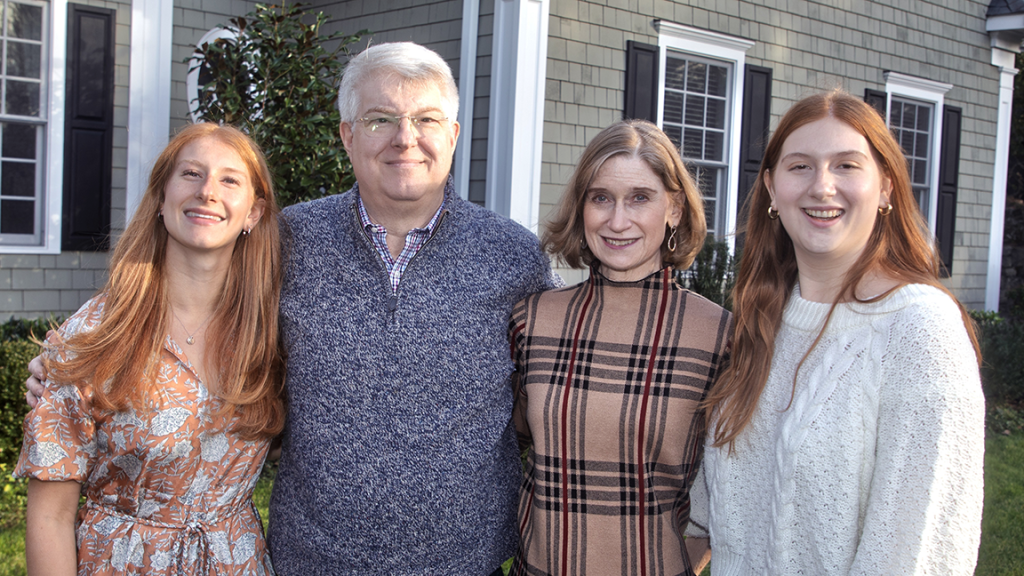
Amiel Goldberg’s path to public service began not in politics, but in his daughters’ public school. A Stamford Westover neighborhood resident since 2007, Goldberg first got involved as a public school volunteer, serving as treasurer of the Stillwater Elementary Parent Faculty Organization.
That community involvement expanded into broader civic engagement, including leadership roles as treasurer of the Jewish Federation and vice president of his synagogue. Those experiences, Goldberg says, taught him the importance of listening carefully, balancing competing priorities, and building consensus.
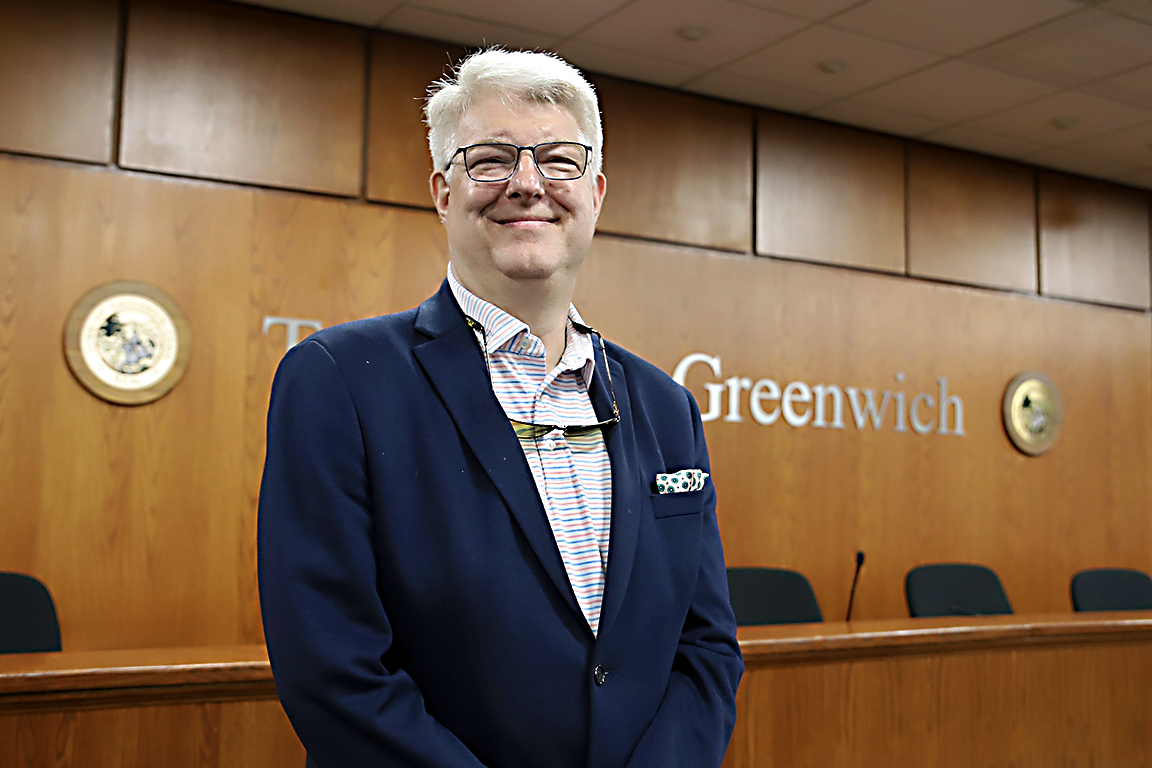
Professionally, Goldberg spent more than three decades in financial risk management, operations research, and data science, holding senior roles at BNY Mellon, IBM, GE Asset Management, and UBS. His work focused on evaluating complex risks, stress-testing assumptions, and planning for long-term stability—experience he believes prepares him well for the state legislature.
Five years ago, Goldberg ran for Stamford’s Board of Representatives—the city’s 40-member legislative body—and won twice in a “purple” district. He’s been focused on constituent service—helping residents navigate city services, improving neighborhood infrastructure, and advocating for quality-of-life issues ranging from traffic safety to sewer expansion.
Focus on results, not ideology
Now Goldberg is running for the State House in the 149th district, which spans parts of Greenwich and Stamford. The seat had been held by Republicans since its creation, until Democrat Rachel Khanna flipped it in 2022.
Goldberg states he felt compelled to run because the current Republican state representative has failed to reflect the moderate values of the district. He points specifically to her many “no” votes on reproductive healthcare funding, gun safety legislation, and millions in state dollars for the district; positions he notes are more aligned with a fringe faction. “I bring a common sense, problem-solving approach to representing the 149th District—focusing on outcomes, not ideology,” Goldberg says.
Election Day is Tuesday, Nov. 3. Reach out now to get involved in Goldberg’s campaign here.
BET Chair Weisbrod answers your questions about town budget & property taxes
Why did my tax bill change? Why are some neighbors seeing different changes? And where is the money going?
These are just a few of the questions likely to be on the minds of property owners in July when they open their property tax bills. The bills will reflect Greenwich’s updated property values and the newly approved Fiscal Year 2026-27 (FY27) town budget.
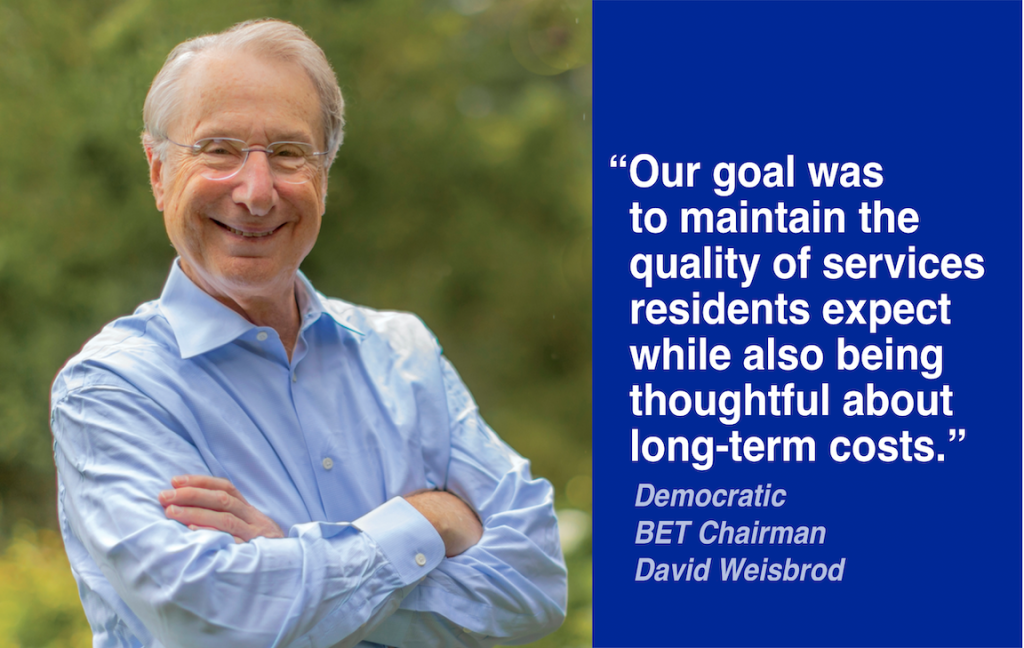
We flagged residents’ most Frequently Asked Questions and invited David Weisbrod, a Democrat and chair of the Board of Estimate & Taxation (BET), to answer them, below.
Why are property tax bills changing this year?
Two things changed at the same time this year: the town updated property values across Greenwich, and the town approved a new budget.
The property value update is called a revaluation. It is required periodically by the state to ensure fairness among residents since homes are taxed based on current market values.
The second part of the equation is the town budget. The budget determines how much money Greenwich needs to collect to pay for schools, police, firemen, roads, parks, libraries and other town services residents use every day.
So, does a revaluation automatically raise taxes?
No. The revaluation changes how the overall tax bill is divided among property owners. It is not intended to increase the total amount of money the town collects.
Think of it this way: the budget determines how big the tax pie needs to be, and the revaluation determines how the pie is sliced. If your property value increased faster than other properties, your slice may become larger. If it increased less than average, your slice may become smaller.
That is why two neighbors on the same street may see different tax changes this year.
Why are some neighborhoods seeing bigger changes than others?
The housing market did not change evenly across town. Some neighborhoods saw home prices rise sharply over the last several years, while others changed more moderately.
Different types of properties also performed differently in the market and properties that have had renovations or other improvements will increase in value accordingly.
As a result, the updated assessments affected owners differently depending on where they live and how their property value changed compared with the rest of town.
We understand that this can be frustrating and confusing, especially when residents compare bills. But much of that difference comes from how individual property values changed during the revaluation process.
How much is the new town budget?
The final FY27 budget approved by the Representative Town Meeting totals $542 million, a 4.1% increase vs. last year.
About $462 million of the FY27 budget will be funded through property taxes while state aid, permits, fees, grants and investment income will fund the remainder.
Why did the budget increase?
A main driver is higher employee salaries due to contractual agreements with labor unions. Also, we faced higher health care costs, an increase in the school bus contract, and an increase to the Town’s Risk Fund.
In addition, we raised the capital tax levy by $5 million as a first step to remediate past years’ deficiencies in financing capital projects. We view this as an investment in Greenwich’s future to help pay for essential projects such as Hamill Rink, and the long-deferred school projects, i.e. Old Greenwich School, Central Middle School, and future projects such as Riverside School and the Greenwich High School campus and pool project.
Did a Democratic-controlled BET affect the budget process?
Yes. This year’s budget process recognized that many residents are concerned about affordability, even as the town faces rising costs for schools, public safety, infrastructure and core town operations.
After months of detailed review with each town department, we Democrats led a successful bipartisan effort to reduce the First Selectman’s original budget proposal by approximately $6 million—while still funding essential town services, as well as our town’s future needs.
Our goal was to maintain the quality of services residents expect while also being thoughtful about long-term costs.
And we’ll start the process all over again this summer as we plan for Fiscal Year 2027-28.
What we’re reading
Governor Ned Lamont last week signed Connecticut’s FY 2027 budget adjustment package into law, calling it a fiscally responsible plan that makes historic investments in education and municipal aid while keeping our state on “stable financial ground.” In a statement, Lamont highlighted increased support for schools, expanded early childhood funding, and measures aimed at improving affordability for residents.
The budget respects Connecticut’s fiscal guardrails while directing much-needed additional resources to local communities. The measure passed with overwhelming bipartisan support in both chambers (157-27)—despite “no” votes from our local Republican delegation members—and was signed into law on May 26. Read the Lamont statement here.
Action Calendar
June 5. Wear orange.
Recognize victims and survivors of gun violence. Speaker: Earl Bloodworth of CT Against Gun Violence. 1-2 p.m., Town Hall Meeting Room, 101 Field Point Road.
June 6. Stand proud.
Raise the flag for Greenwich Pride, 4 p.m., Greenwich Town Hall, 101 Field Point Road.
June 12. Engage.
Join Greenwich Selectwoman Rachel Khanna for coffee and conversation at 1 p.m. Hear about what’s happening in town and bring your questions or comments. Coffee for Good, 48 Maple Avenue.
June 15. Learn.
Hear law professor and New York Times bestselling author Melissa Murray on her new book, “The U.S. Constitution: A Comprehensive and Annotated Guide for the Modern Reader.” Space limited; registration required. 7 p.m., First Congregational Church, 108 Sound Beach Avenue, Old Greenwich.
June 17. Meet.
Greenwich Democratic Town Committee meetings are open to all local Democrats. Special guest speaker Stamford Mayor Caroline Simmons. Join us 7:30-9 p.m. in the Meeting Room at Town Hall, 101 Field Point Road.
| Volume 4, Number 49 • June 4, 2026 |
| Paid for by the Greenwich Democratic Town Committee. |
| Greenwich Democratic Town Committee P.O. Box 126 Greenwich, CT 06836 |