
Utility executives correct the record
For weeks, First Selectman Fred Camillo has told Greenwich residents the sky is falling — blaming state housing laws for pushing gas, water, and electric infrastructure to the breaking point. But when utility executives came to Town Hall, that narrative fell apart.
In July, Camillo called for an immediate statewide moratorium on housing mandates, saying Hartford had “taxed our infrastructure to the point that we can no longer keep up.” The town’s press release blamed utility capacity constraints on state housing mandates that bypass local zoning. Camillo pointed to anecdotes from homeowners who recently enlarged or rebuilt homes only to learn a utility upgrade was needed — or couldn’t be done right away.
The record set straight
Some real infrastructure issues exist. But at the recent utilities forum, representatives from Connecticut Natural Gas (CNG), Aquarion, and Eversource described a far calmer reality.
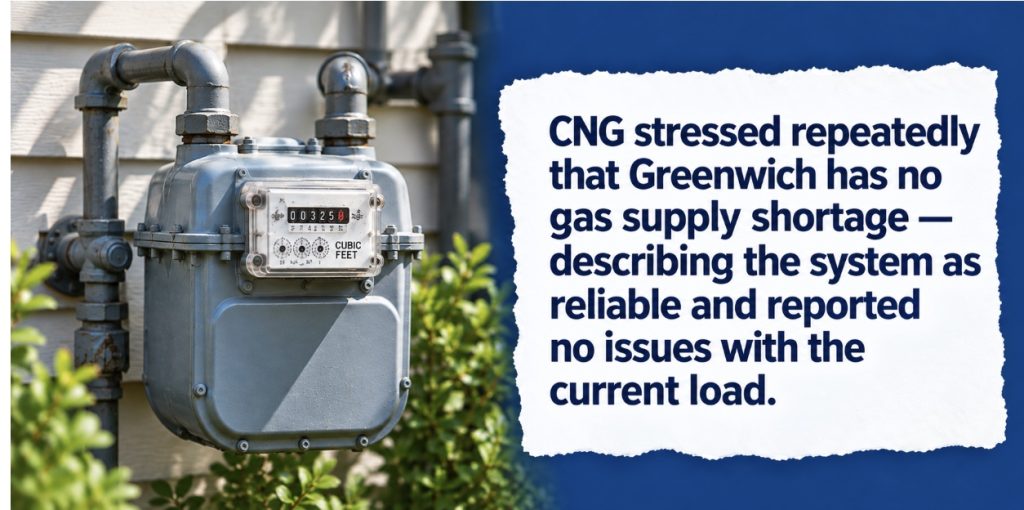
CNG stressed repeatedly that Greenwich has no gas supply shortage — describing the system as “reliable” and reported “no issues with the current load.” The real issue is localized distribution constraints in an aging network, and CNG is already designing Greenwich upgrades.
More telling: CNG said ordinary home additions usually aren’t the issue. Expanding a 1,500-square-foot house to 2,000 square feet typically adds an insignificant load; only larger projects, whole-house generators, or other substantial new demand trigger individual review.
Aquarion said the same — capacity and water supply are there, though specific properties may need upgrades due to elevation, fire-flow rules, irrigation, or unusually high demand.
Eversource’s engineer put it bluntly: “We do not have a major capacity issue.”
Nothing at the forum tied these localized concerns to 8-30g, the state law allowing developers to bypass certain zoning rules when at least 30% of a project’s units are affordable. Notably, the town’s own 2024 data show only nine 8-30g projects — 181 units total — have been built townwide in the roughly 35 years since the law passed.
So why blame affordable housing?
It looks like an election-season scare tactic: Manufacture a crisis and find an easy scapegoat.
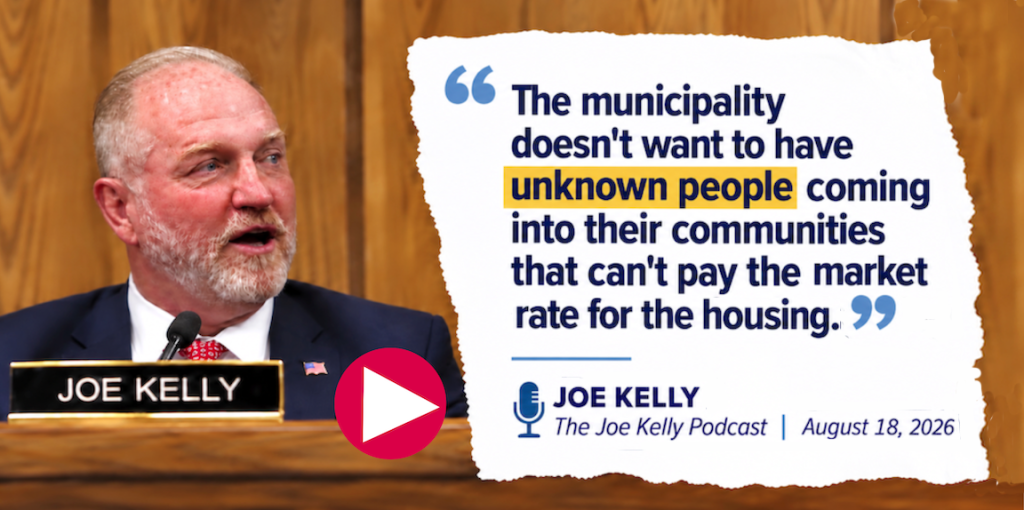
Republican CT State Senate candidate Joe Kelly went further on his podcast, describing a “push-pull” over the state’s directive for affordable housing: “The municipality doesn’t want to have unknown people coming into their communities that can’t pay the market rate for the housing,” Kelly said. “So, but therefore we have to find some balance in between the two because each makes sense.”
That’s an astonishing way to talk about our neighbors.
There are real problems with 8-30g. It’s clear municipalities are best positioned to make local zoning decisions, not Hartford. But that’s very different from suggesting, as Kelly put it, the problem with affordable housing is those who live in it.
Residents looking for affordable housing aren’t “unknown people” to keep out. They’re teachers, firefighters, health care workers, employees at local businesses, young families, seniors and people who grew up here but can’t afford to stay.
The case for local zoning control can stand on its own, without painting people who seek affordable housing as outsiders and without manufacturing a fake utility crisis.
Solar is cheap. So why vote against it?
The summer of 2026 brought a stark reminder about the urgency of developing affordable renewable energy. It was the hottest summer ever recorded in the contiguous United States, and in western Europe. At the same time, the war in Iran is hitting our wallets. Disruptions to oil shipments through the Strait of Hormuz have sharply reduced Gulf supplies, helping push oil above $100 a barrel and U.S. diesel prices to record highs.
There is an obvious solution: Solar power and other renewables are the cheapest source of new electricity available. Period. Lazard’s 2026 analysis found renewables remain the lowest-cost form of new power generation even without subsidies. Connecticut’s grid operator, ISO‑New England, has stated that the region needs more diverse and renewable energy sources to maintain reliability. Solar, particularly rooftop and community solar, reduces strain on the grid.
So how have our Republican legislators, Sen. Ryan Fazio and Rep. Tina Courpas, voted when Connecticut has tried to expand solar?
Who would vote against reducing energy costs?
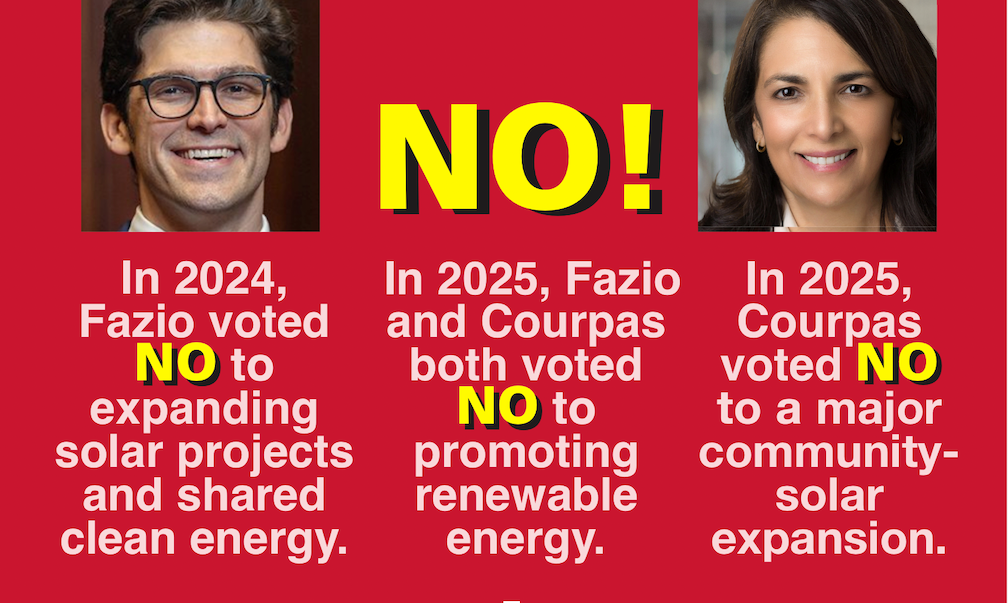
Fazio voted against a major 2024 law expanding solar projects and shared clean energy. In 2025, both Fazio and Courpas voted against HB 5004, which promoted renewable energy and became law. Courpas also voted against HB 7087, a major community-solar expansion.
And in 2026, both voted against HB 5340, which expanded Connecticut’s residential, commercial and community solar programs and agrivoltaics. It became law anyway.
You can’t be for lowering electricity prices while voting against solar and wind power. We expect more from our elected representatives than acting as servants to Trump’s war against renewable energy. Connecticut needs more affordable, homegrown energy—not less.
What we’re reading
Protecting our democracy takes more than defeating one politician. This thought-provoking essay outlines how Donald Trump isn’t the cause of America’s political dysfunction, but a symptom of deeper problems that have been building for decades — from growing economic inequality and weakened institutions to declining trust in government. It’s a good reminder that if we want a stronger democracy, we also have to address the conditions that make authoritarian politics appealing in the first place.
Action Calendar
September 19. Make your plan to vote.
The state’s online absentee ballot application portal opens for the Nov. 3 election. Absentee ballots will be mailed out from the Town Clerk beginning Oct. 2 to those who have submitted applications. Any eligible voter can request an absentee ballot. No excuse is needed. Get all your voting info here.
September 22. Help us win.
Volunteers needed, no experience necessary. Join us in our campaign headquarters to help elect our Democratic team. Make calls, knock doors, write postcards and more. Click here to RSVP. Same time and the same place every Tuesday: 4-7 p.m. at Campaign Headquarters, Venture X, 200 Pemberwick Road, 2nd Floor, Room 229.

September 23. Learn.
Join a conversation with Secretary of the State Stephanie Thomas to learn the latest on voting in Connecticut 4-5 p.m., Greenwich Town Hall Meeting Room.
September 23. Join us.
Greenwich Democrats meetings are open to all Democrats in town. Join us at 7:30 p.m. in the Town Hall Meeting Room at Greenwich Town Hall Meeting Room, 101 Field Point Road.
September 26. ¡Celebremos!.
Meet our Democratic candidates (conozca a los candidatos) and celebremos el Mes de la Herencia Hispana (celebrate Hispanic Heritage Month). Saturday, Sept. 26 (sábado 26 de septiembre), 4-6 p.m. at the Bendheim Western Greenwich Civic Center Playground, 449 Pemberwick Road. More information and RSVP here.
| Volume 5, Number 12 • September 17, 2026 |
| Paid for by the Greenwich Democratic Town Committee. |
| Greenwich Democratic Town Committee P.O. Box 126 Greenwich, CT 06836 |