
Greenwich can make better use of special committees
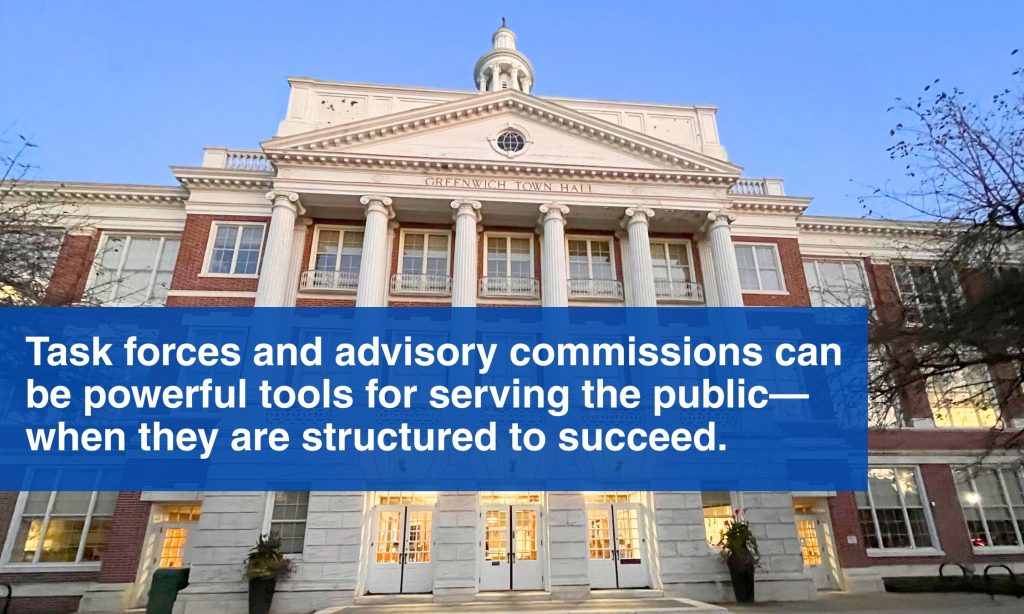
Task forces and advisory committees can be powerful tools for serving the public—when they are structured to succeed. In Greenwich, however, the way these bodies are currently organized and managed often limits their effectiveness.
A complex and vague system of committees
If you look at the long list of special committees appointed by the First Selectman, it quickly becomes clear that the system has grown complex—arguably too complex to function efficiently. Instead of streamlining decision-making, the proliferation of committees can create confusion, overlap, and delay.
Volunteers interviewed for this story described a recurring pattern: some committees appear to begin with unclear missions or predetermined directions, while others lack defined goals and deliverables altogether. In either case, participants can feel disempowered, unsure how their work will translate into tangible outcomes. When a committee operates without clear structure, it can begin to feel less like a vehicle for action and more like a substitute for it.
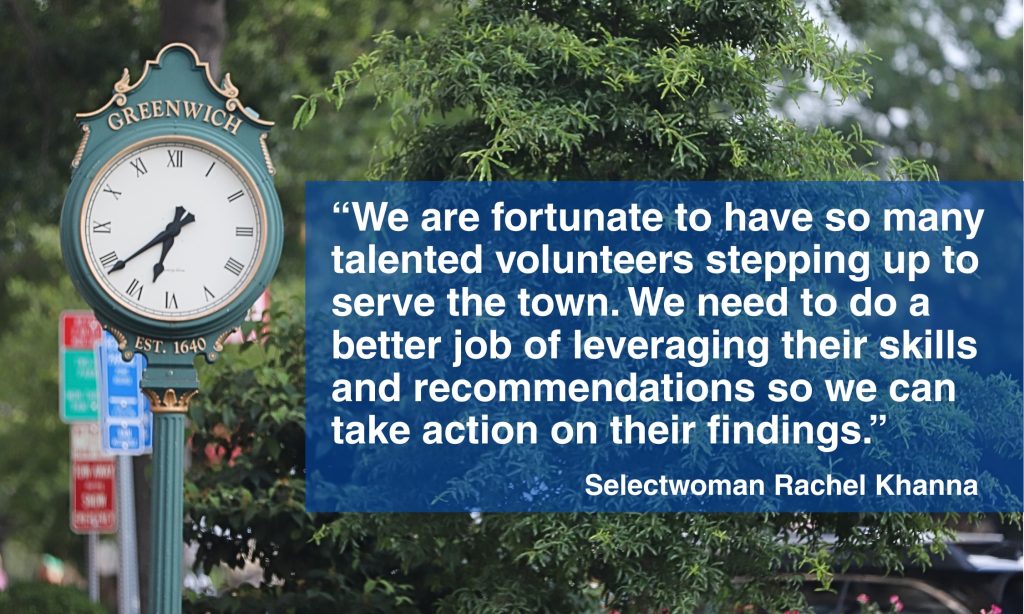
The issue is not the people serving on these committees. As Selectwoman Rachel Khanna noted, “We are fortunate to have so many talented volunteers stepping up to serve the town. We need to do a better job of leveraging their skills and recommendations so we can take action on their findings.”
Outcomes are predetermined at times
A broader concern is understanding whether these task forces are empowered to do anything. In some cases, residents feel that options are not fully explored in a transparent, comparative way—such as presenting multiple scenarios with clear cost analyses—before momentum builds around a particular outcome. When public hearings occur, some participants perceive that feedback has limited influence on final decisions, which can erode trust in the process.
The debate over the historic Havemeyer Building illustrates these tensions. At a task force public hearing last June to present a plan for a hotel, residents voiced strong preferences for keeping the property under town control, suggesting uses such as continued Board of Education space, senior services expansion, housing, or a performing arts center. Despite the range and volume of feedback, many attendees felt the process did not meaningfully incorporate their input into the path forward.
A disconnect between committees and policy
Other committees face a different challenge: limited authority or resources. The Energy Management Advisory Committee, for example, produces detailed annual reports outlining ways to reduce energy consumption and potentially save taxpayers millions. Yet without a budget, formal oversight responsibilities, or clear integration into decision-making channels, its recommendations have had limited impact. As a result, energy use has remained largely unchanged while costs continue to rise.
Similarly, the Greenwich Active Transportation Task Force has helped elevate pedestrian and cyclist safety as a priority. But without a defined timeline or concrete deliverables, its ability to translate ideas into implemented policy is constrained.
Several other committees—including those focused on sustainability and combating hate—operate with broad mandates but lack clear timelines, decision pathways, or accountability mechanisms. These structural gaps make it difficult to move from discussion to measurable results.
Newer initiatives, such as the Arch Street Task Force, highlight both the opportunity and the risk. Its success will depend on whether the task force members are given clear missions, defined timelines, and meaningful mechanisms for incorporating community input. Without those elements, they risk following the same pattern seen in earlier efforts.
Let’s make the most of Greenwich’s volunteer talent pool
With the creation last week of another task force, this time focused on AI, it’s worth considering how to set these committees on a path to success. For task forces to deliver real value, they need:
- Active and consistent involvement by town leaders in the committee’s work;
- Specific, time-bound deliverables;
- Transparent decision-making processes;
- Structured pathways from recommendation to action;
- Consistent integration of community input
Greenwich has no shortage of expertise, civic engagement, or willingness to serve. What’s needed is a framework that can convert those strengths into results.
The meter is running on the First Selectman’s legal crusade
Sixteen months after First Selectman Fred Camillo filed a lawsuit in Stamford Superior Court against our own Board of Education (BOE), taxpayers are still footing the bill—while the core issues in the case have largely been resolved.
The dispute began when the First Selectman attempted to appoint his buddy Paul Cappiali to a BOE vacancy. The BOE asserted that the First Selectman did not have the authority to make such an appointment, and the First Selectman responded by filing suit seeking to install his pal.
Today, the lawsuit’s main claim is effectively moot. Cappiali is now serving on the BOE following the November 2025 election, and there is no current vacancy to test the broader claim of appointment authority.

Meanwhile, legal costs continue to mount on both sides of the case, totaling $500,000 and counting. The town is paying Camillo’s legal bills, but has refused to pay for the BOE’s defense, withholding already approved funds in the BOE budget and ignoring the statutory obligation to indemnify volunteers for their work.
The case is not scheduled to start trial until April 2027. With the underlying dispute already settled, residents are left asking: why is the First Selectman’s lawsuit still moving forward—and at what cost to taxpayers?
What we’re reading
The Trump administration last week criticized Greenwich’s use of federal Community Development Governor Ned Lamont signed an executive order to develop a plan to reform the funding used for the state’s K-12 public schools’ operations. He argued that the existing methods—including Education Cost Sharing (ECS) grant—were developed several generations ago and need updating to serve present needs.
Congressman Jim Himes, top Democrat on the U.S. House Intelligence Committee, introduced an amendment recently to reauthorize Foreign Intelligence Surveillance Act (FISA). The amendment would require FBI agents to seek approval from a special court any time they want to obtain Americans’ private communications data.
Action Calendar
April 24. Show up.
Attend the YWCA Greenwich’s annual Stand Against Racism event at noon at Greenwich Town Hall. Click here for more info. 101 Field Point Road.
April 30. Touch grass.
Help Friends of Pomerance plant native plants at the park. Meet at the Hobbit House near Pomerance Pond via the Orchard Street entrance. Bring gloves, water and wear pants and sturdy shoes. 9:00-noon. Register here.
| Volume 4, Number 43 • April 23, 2026 |
| Paid for by the Greenwich Democratic Town Committee. |
| Greenwich Democratic Town Committee P.O. Box 126 Greenwich, CT 06836 |