
GHS science program produces national leaders
In the last 20 years, over 1,000 students have cycled through science teacher Andrew Bramante’s Independent Science Research class at Greenwich High School (GHS), a program that allows students to design and execute research projects over multiple years, and compete in national and international science fairs. The program has helped launch students into careers in biotechnology, engineering, environmental science, and other cutting-edge fields.
A 2015 Popular Mechanics article put it best: “If science fairs were sport, Greenwich High would be the New York Yankees.”
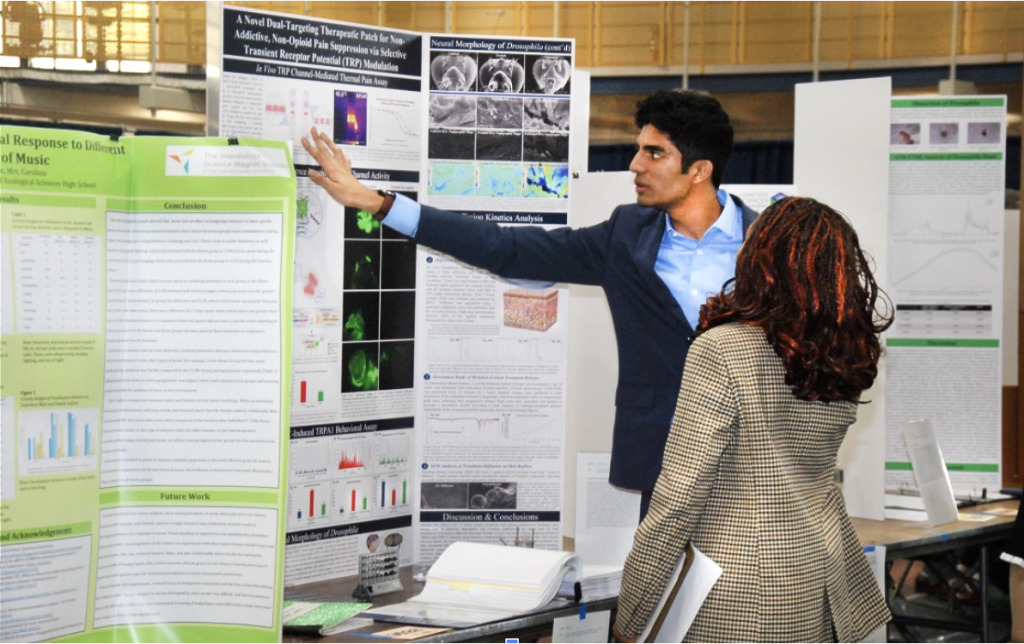
This year has been no different. At the CT Science and Engineering Fair, 14 of 18 GHS participants were named finalists, placing them in the top 20% of projects at the fair.
Student research tackling big problems
Among the standout students was Marley Wies, whose work tackles textile waste. When cotton fabric is cut for manufacturing, large amounts are discarded, with a great environmental impact, and traditional recycling methods degrade the fibers beyond reuse. Wies spent more than 400 hours developing a chemical process that breaks down cotton into reusable fibers with over 70% recovery. Wies earned first place in Physical Sciences, received the Gerber Medal of Excellence, and will represent Greenwich at the 2026 Regeneron International Science and Engineering Fair.
Biomedical research also featured among this year’s winners. Lula Wang was recognized for designing a nanotherapeutic treatment for leukemia, securing second place in Life Sciences and a spot at the Regeneron competition. Meanwhile, Rajsi Choudhary focused on early detection of kidney disease—a condition affecting one in seven American adults, often without symptoms. Her research explores a saliva-based diagnostic tool that could allow for at-home monitoring of kidney health, reducing the need for invasive testing and enabling earlier intervention.
Powered by investment in public education
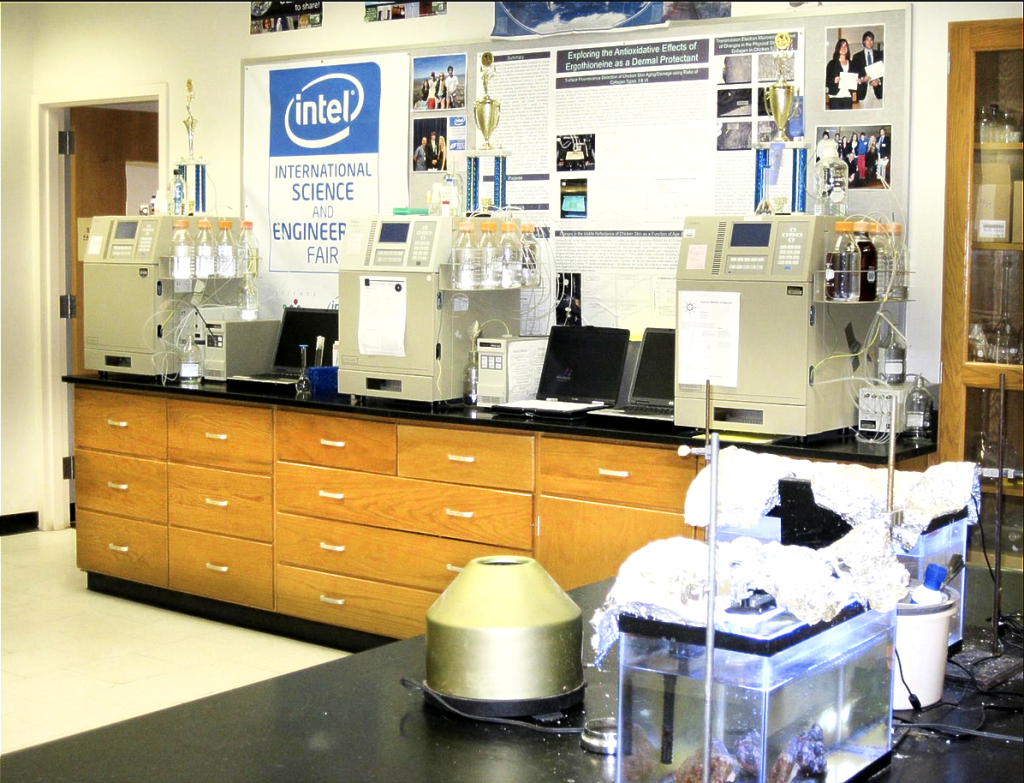
What sets GHS’s program apart is the district’s investment in labs and technology that allow students unlimited time and access for their research. Program advisor Andy Bramante noted, “many of the projects on this year’s docket would not have been possible without our newest equipment,” such as the multi-channel fluorescent microscope, which “transports our kids to a university-lab environment without leaving the science wing.”
The results speak for themselves. Over the past six years, Greenwich students have earned 28 Regeneron Scholars and four Finalists—far outpacing neighboring districts.
In her book about the program, journalist Heather Won Tesoriero described Bramante’s class as one with, “no curriculum, tests, textbooks, or lectures” and in “equal parts elite research lab, student counseling office, and teenage hangout spot.”
A springboard for real-world impact
Graduates are translating those skills into real-world impact. Raina Jain, a 2020 graduate patented a device she designed in Bramante’s class to prevent mites from entering beehives, a leading killer of honeybee colonies. Another graduate, Will Yin, started a company, Mandolin, to improve patients’ access to medications for immune disorders, cancer and Alzheimer’s disease. Alex Kosyakov, a 2019 graduate, launched a company, Natrion, that focuses on improved processes for creating electric vehicle batteries.
At a time when the future of American competitiveness depends on innovation, GHS’s science research program stands as a powerful example of what public education can achieve when students are given the tools–and the trust–to explore.
Lawmakers move to protect ratepayers as Aquarion sale nears
Last week, the state legislature’s Energy and Technology Committee advanced a bill aimed at extending the Public Utility Regulatory Authority’s (PURA) ability to oversee Connecticut’s quasi-public water utility, an effort to maintain a check on future rate increases.
In 2024 Eversource signaled interest in selling Aquarion, raising concern among state officials that the water system could be purchased by an out-of-state or investor buyer. In 2024, Connecticut lawmakers passed legislation to form a quasi-public entity, the Regional Water Authority, that could acquire Aquarion and keep control of a major drinking water system in-state and under a public-oriented model. Yet, as the deal moved closer to approval, concerns grew that the transaction could lock in higher water costs with weaker oversight for decades.
Attorney General William Tong has been one of the most vocal opponents, warning that the deal’s underlying costs pose a fundamental risk. “This deal is way too expensive, not in the public interest,” Tong said, arguing that “Eversource executives and shareholders are going to be rolling in cash while the rest of us are saddled with $6 billion in transaction costs for decades upon decades.”
Those concerns have prompted action at the Capitol. Last week, Energy and Technology Committee members passed a bill to give PURA continued oversight of water rate-setting even after the sale of Aquarion to the Regional Water Authority. The bill now goes to the General Assembly for a vote.

What we’re reading
The Political Brain by Drew Westen. Psychologist and Emory University professor Drew Westen uses neuroscience and political history to argue that winning elections requires appealing to emotion, not logic. Although written in 2007, his case that a compelling story outweighs policy ideas is remarkably prescient in our modern political era of heightened polarization. It remains an essential guide for understanding why feelings still dominate the ballot box in the digital age.
Action Calendar
March 26. Speak up.
Got something to tell the Board of Estimate & Taxation about the town budget? Sign up to speak at the public hearing to be held tonight at 7 p.m. in the Town Hall Meeting Room, 101 Field Point Road.
March 28. Rally.
Join neighbors, community members, and elected officials for a peaceful outdoor gathering in support of democratic values and our US Constitution. No Kings Rally & March, 2-3 p.m., Havemeyer Building, 290 Greenwich Avenue.
April 2. Enroll.
Open enrollment for the new Central Middle School closes at midnight for 6th, 7th and 8th graders who live in households zoned for Eastern and Western Middle Schools.

April 15. Apply.
Dedicated college-age students may apply to be Himes for Congress Fellows. This program is a part of the 2026 National Democracy Summer Program spearheaded by Congressman Jamie Raskin, created to train, and educate college and high school-aged students as political activists, organizers, and leaders. The application period is now open. The priority application deadline is April 15.
April 18. Clean up.
The Town of Greenwich Parks and Recreation Foundation hosts its annual Earth Day Clean-Up & Beautification event on Saturday, April 18 from 9 a.m. to 12 p.m. at Mianus River Park. Volunteers are encouraged to meet at the Cognewaugh Road entrance of the park.
| Volume 4, Number 39 • March 26, 2026 |
| Paid for by the Greenwich Democratic Town Committee. |
| Greenwich Democratic Town Committee P.O. Box 126 Greenwich, CT 06836 |