
Why other Fairfield County towns pay less—and what we can do about it
Many Connecticut towns are aggressively saving money on energy conservation, and solar and low-carbon technology, but not Greenwich. Instead, energy costs in town have skyrocketed 40% in five years, according to Greenwich’s Energy Management Advisory Committee.
The EMAC committee, appointed by First Selectman Fred Camillo, reports that the town failed to make progress toward its goals, such as reducing energy costs 20-40%, and tamping down usage. This is unfortunate since, “in rough terms, a 20% reduction in energy use could represent savings of $1-2 million,” the 2024 report states.
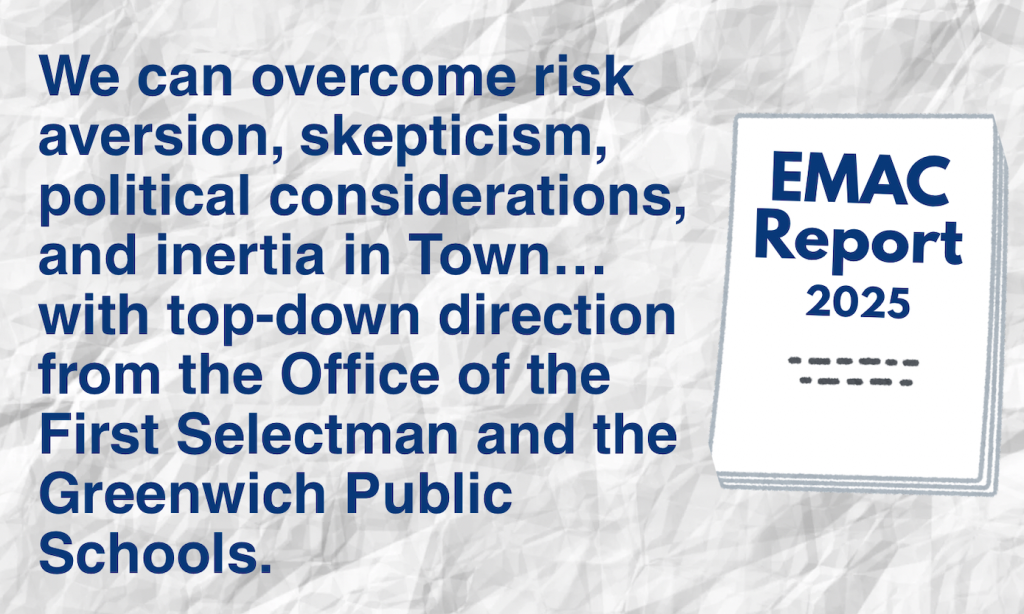
To change our energy performance, “We can overcome risk aversion, skepticism, political considerations and inertia in Town through collaboration with other nearby cities and municipalities embracing energy efficiency, with top-down direction from the Office of the First Selectman and the Greenwich Public Schools,” the 2025 report states.
Other towns are saving—what are they doing differently?
The town of New Canaan installed solar panels on roofs of five town buildings and all five schools. Former First Selectman Kevin Moynihan estimates the town saves $1 million a year by these initiatives. Furthermore, the schools signed power purchase agreements that did not require upfront investments.
Fairfield boasts over $2.4 million savings in annual avoided energy costs as a result of town and residential solar installations. Key initiatives include a large solar array at a former landfill, which has contributed to millions in cumulative multi-year savings, according to the town’s website.
The city of Stamford has approved solar at Stamford High School, which is expected to provide an average annual revenue stream of over $111,000, while covering nearly 30% of the school’s energy consumption.
Powering in place saves money
When power is generated at the source of consumption, it can save 5-15% in energy, since it isn’t lost in transmission, according to Mark Robbins, founder of MHR Development, LLC, an energy and sustainable development firm.
Energy can be created at the point of consumption by solar, combined heat and power (CHP) generators, and geothermal. CHP gas generators create substantial savings since the heat created from energy production is captured at the site and used to warm the building. Also, Robbins says that geothermal can be “huge” in the future, since it creates savings by using the consistent 55-degree temperature below the frost line, to help warm when it is colder outside, and cool when it’s warmer.
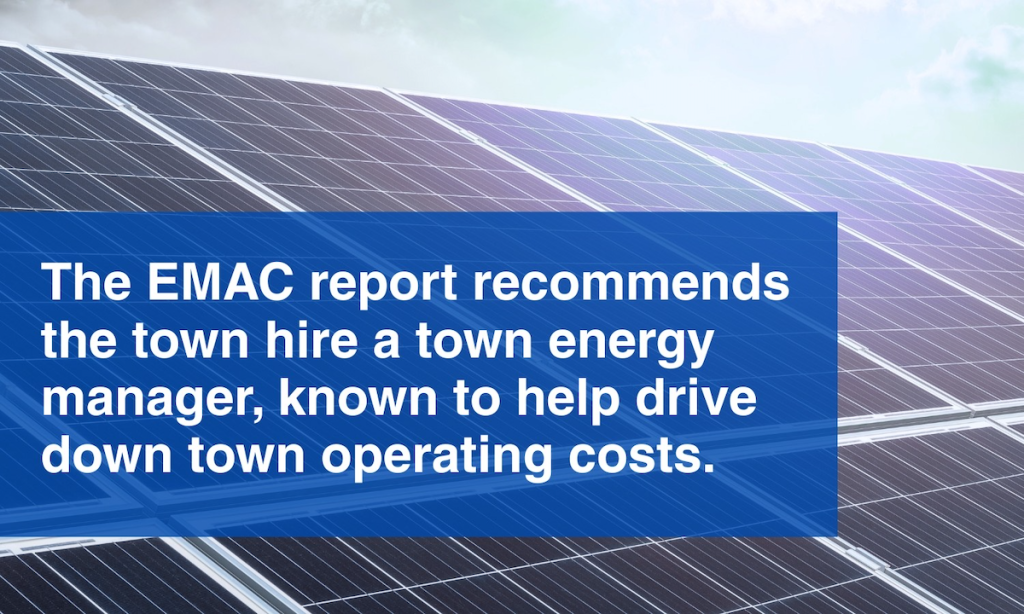
The EMAC report recommends that Greenwich hire a town energy manager, known to help drive down town operating costs. The position could help town officials navigate the layers of programs available to reduce energy waste and transition to cheaper energy sources, while obtaining federal and state resources to offset the costs.
Selectwoman Rachel Khanna supports the new position, because “it would ensure that we are getting economies of scale on construction projects, leveraging any available tax credits and building institutional knowledge for future projects.”
The opportunities for help in energy saving are vast. Eversource offers rebates, incentives, guaranteed lower energy prices, 0% financing, and free energy assessments. The Department of Energy has grants such as the State Energy Program for local projects and Tax Incentives Assistance Projects for investments. These programs offer rebates for insulation, natural gas boiler conversions, and technical assistance for energy conservation.
Having an energy manager could ensure energy infrastructure is maintained. Such a position could help the town avoid issues such as a breakdown of the Hamilton Avenue School geothermal system and the solar panel system at New Lebanon that was not connected. With the potential cost savings, we can’t afford to let inefficiency continue to strain our town budget.
Connecticut moves toward no-excuse absentee voting
In 2024, Connecticut voters approved a constitutional amendment authorizing no-excuse absentee voting. Now, with proposed House Bill 5001, Connecticut legislators may finally make that change a reality.
Today, Connecticut is one of only 14 states requiring voters to provide a specific excuse to cast an absentee ballot. Under current law, voters must certify that they will be out of town, are ill or disabled, serving in the military, observing a religious restriction, or working at the polls. The new legislation would remove outdated hurdles and allow any eligible voter to request an absentee ballot. Despite the clear public support for the change, Republican State Senator Ryan Fazio opposed it.

“We live in a complicated world. We have sudden travel plans and emergencies that take us outside our district,” explains State Representative Steve Meskers. “This change provides people the flexibility to decide to vote absentee.” State Representative Hector Arzeno describes the bill as, “vital additional protection for voters across the state.”
Protecting ballot access
Modernizing Connecticut’s laws is especially critical now as voting rights face new threats elsewhere. At the federal level, the Safeguard American Voter Eligibility (SAVE) Act has recently passed through the U.S. House, proposing restrictive new proof-of-citizenship requirements for voter registration. Would-be voters could be forced to obtain passports, track-down decades-old birth certificates, with people whose names have changed through marriage facing particular obstacles.
As Selectwoman Rachel Khanna notes, the federal proposal functions more like a “Make it Harder to Vote Act.” Non-citizen voting is already illegal and extremely rare. The real problem here is not widespread fraud—it’s a danger of disenfranchising millions of eligible voters.
Our Democratic state officials serve as a firewall ensuring Connecticut does not follow the restrictive path of places like Florida. As voting access is threatened nationwide, our state is moving in a positive direction. Who we choose in the November state elections will determine whether we continue on this trajectory.
What we’re reading
A trio of Connecticut pizzerias have defined their own New Haven-style pie over the last century, known simply as ‘apizza.’ New Yorkers are eating it up.
Action Calendar
March. Enroll.
The new Central Middle School is continuing open enrollmentfor 6th, 7th and 8th graders who live in households zoned for Eastern and Western Middle Schools. Open enrollment closes Friday, April 3, at midnight.
March 22. Parade.
March with the Democrats in the Greenwich Avenue St. Patrick’s Parade. Gather before the parade at 1:30 p.m. in the parking lot at Town Hall, 101 Field Point Road. Look for our banner.
March 25. Participate.
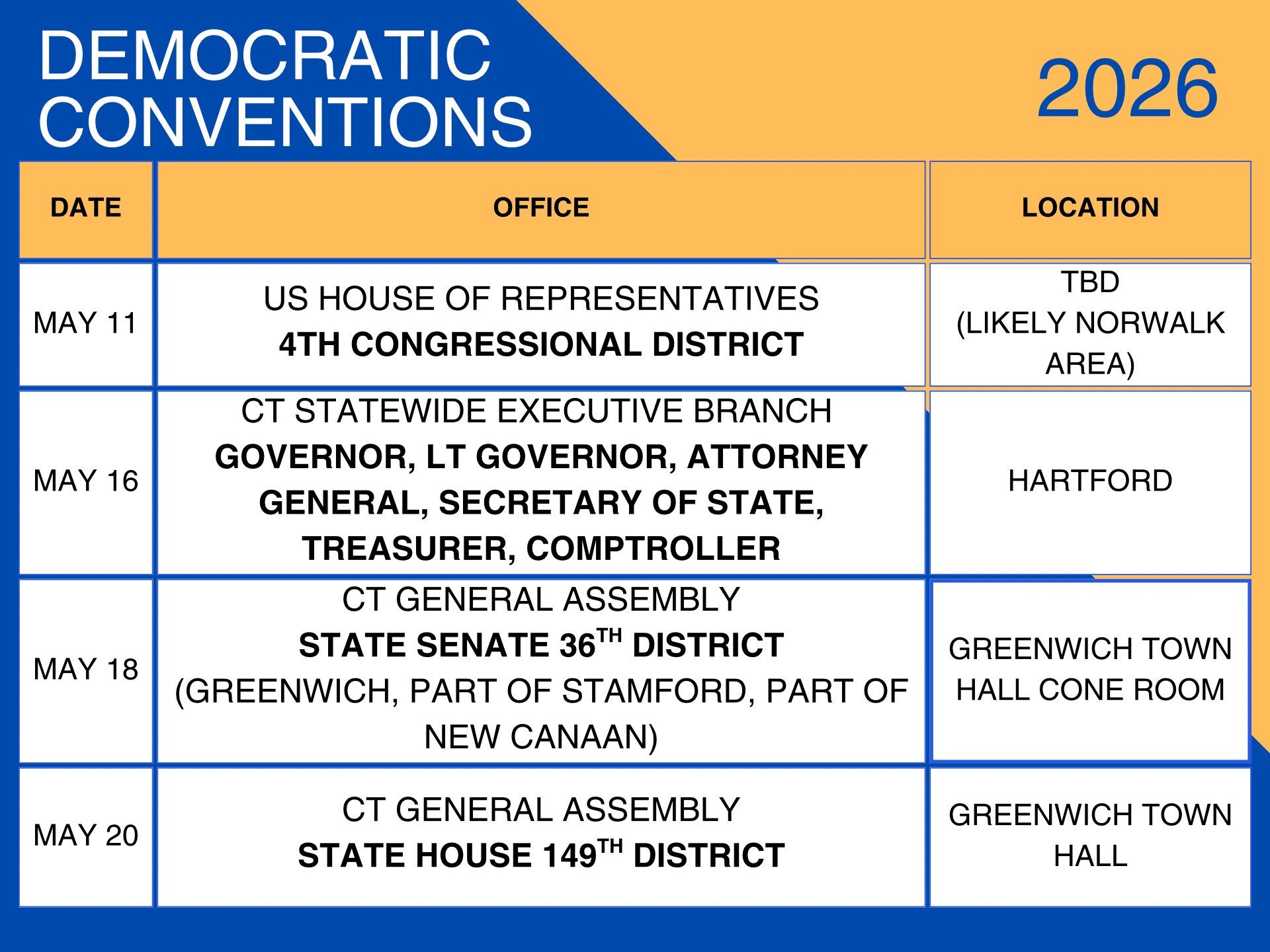
The Democratic Town Committee (DTC) will elect delegates to four upcoming state political conventions.(See timeline below.) Delegates will vote at the conventions for candidates to run in the November elections. To be eligible to become a delegate you must be a Democrat registered to vote in Greenwich. 7:30 p.m., Greenwich Town Hall, 101 Field Point Road.
March 26. Speak up.
Got something to tell the Board of Estimate & Taxation about the town budget? Sign up to speak at the public hearing to be held at 7 p.m. in the Town Hall Meeting Room, 101 Field Point Road.
March 27. Rally.
Join neighbors, community members, and elected officials for a peaceful outdoor gathering in support of democratic values and our US Constitution. No Kings Rally & March, 2-3 p.m., Havemeyer Building, 290 Greenwich Avenue.
| Volume 4, Number 38 • March 19, 2026 |
| Paid for by the Greenwich Democratic Town Committee. |
| Greenwich Democratic Town Committee P.O. Box 126 Greenwich, CT 06836 |